Ozymandias By Percy Bysshe Shelley
November 06, 2026
I first read "Ozymandias" by Percy Bysshe Shelley when I was in Class 10, as part of our English literature syllabus. What I liked about this poem, even back then, was how short it was. It is such a small poem, yet it creates such a vivid picture in the mind. At that age, I don't think I understood all its deeper meanings, but I remember liking it. Reading it again now, I find it even more beautiful. There is so much packed into those few lines, and I love how Shelley manages to express so many ideas through one simple image of a ruined statue in the middle of a vast desert.
What makes the poem especially interesting to me is how beautifully it captures the power of nature and the temporary nature of human pride. Ozymandias was a powerful king who believed that his greatness would exist forever. When he calls himself "King of Kings", we can imagine how proud he must have been of his power and achievements. He probably thought that the enormous statue built in his honour would stand for eternity, reminding everyone of his greatness. But the condition of the statue tells a completely different story. It is broken, surrounded by an endless desert, and his kingdom is nowhere to be seen. All that remains is a ruined monument.
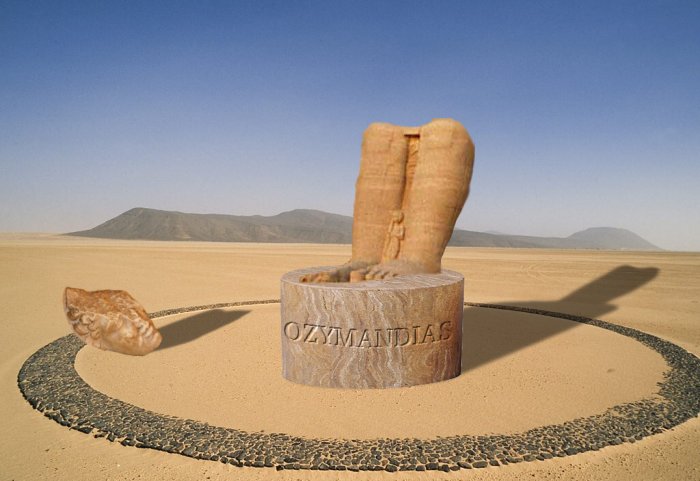
Ozymandias Broken Statue (Source)
This is what makes the poem so interesting to me. The king's pride seems almost foolish when we look at what time has done to his achievements. He believed he was powerful enough to leave a permanent mark on the world, but nature eventually reduced everything to ruins. It makes me think about how temporary pride really is and why we should never consider ourselves greater than the forces of nature and time.
This idea also brings to mind Shakespeare's "Sonnet 65", where he reflects on how time can destroy even the strongest monuments and the most beautiful things. There is an interesting connection between the two poems: Ozymandias wanted his statue to preserve his greatness, but it is Shelley's poem that has kept his story alive, though not in the way he would have wanted. It makes me wonder whether true immortality lies not in power, but in the art and ideas we leave behind.
About the Poet
Percy Bysshe Shelley was an English Romantic poet born on 4th August 1792. He is known for his poems that explore nature, freedom, power, and human emotions. His writing often questions established authority and reflects on the temporary nature of human achievements. "Ozymandias" is one of his best-known poems and is a wonderful example of his ability to express deep ideas through powerful imagery. Shelley died on 8th July 1822, but his poetry continues to be read and appreciated.
The Mysterious Traveller and the Ruined Statue
I met a traveller from an antique land
Who said: Two vast and trunkless legs of stone
Stand in the desert. . . . Near them, on the sand,
Half sunk a shattered visage lies, whose frown,
The poem begins with the speaker telling us about a traveller he once met. The traveller comes from an ancient land and describes something unusual that he has seen in a desert. There are two enormous stone legs standing without a body, and nearby lies a broken face that is partly buried in the sand.
The description immediately creates an image of a once-great statue that has been destroyed over time. What I find interesting is that Shelley does not introduce the king directly. Instead, he introduces us to the remains of his statue through the words of a traveller. This makes the story feel distant and mysterious.
Some words:
Antique land: An ancient or very old country. It suggests that the events and the ruins belong to a distant past.
Vast: Extremely large or enormous. Here, it describes the huge stone legs of the statue.
Trunkless: Without a trunk or main body. The statue has lost its upper body, leaving only its legs standing.
Visage: A person's face or facial appearance. Here, it refers to the broken face of the statue.
Shattered: Broken into pieces. It shows how badly the statue has been damaged.
Even the greatest monuments can become nothing more than broken remains with the passage of time.
The Expression of Pride and Cruelty
And wrinkled lip, and sneer of cold command,
Tell that its sculptor well those passions read
Which yet survive, stamped on these lifeless things,
In these lines, the traveller describes the expression on the broken face of the statue. Its wrinkled lips and arrogant smile suggest that Ozymandias was a proud and commanding ruler. Even though the statue is broken, its expression still communicates the king's personality.
The sculptor must have understood the king's character very well because he managed to capture his arrogance and commanding nature so accurately. Interestingly, although the king himself is long gone, his emotions and personality still survive through the expression carved into the stone.
Some words:
Wrinkled lip: The shape of the lips on the statue, suggesting an expression of arrogance or contempt.
Sneer: An expression of disrespect, superiority, or mockery. It suggests that the king looked down upon others.
Cold command: An expression of authority without warmth or kindness. It reflects the king's harsh and dominating personality.
Passions: Strong emotions or feelings. Here, it refers to the pride, arrogance, and cruelty of Ozymandias.
Stamped: Impressed or carved firmly onto something. The sculptor has captured the king's emotions in the stone.
What I find particularly interesting here is that the king's power has disappeared, but his arrogance is still visible. It is almost as if the statue has preserved the very personality that eventually makes his downfall so ironic.
Time may destroy a person, but the impressions they leave behind can sometimes survive.
The Sculptor's Art and the King's Pride
The hand that mocked them, and the heart that fed;
And on the pedestal these words appear:
My name is Ozymandias, King of Kings;
These lines introduce an interesting contrast between the sculptor and the king. The sculptor's hand created the statue by carefully capturing the king's expressions, while the king's heart was filled with the emotions of pride and arrogance. The word "mocked" here can suggest both imitation and a subtle sense of ridicule.
The poem then shifts our attention towards the inscription on the pedestal. It proudly announces the king's name and title: "King of Kings". This tells us that Ozymandias considered himself superior to all other rulers and wanted his greatness to be remembered forever.
Some words:
Mocked: In this context, it suggests imitating or reproducing something. The sculptor reproduced the king's expressions in stone. It can also carry a sense of irony, as the statue eventually becomes a reminder of the king's foolish pride.
Heart that fed: Refers to the king's emotions and personality that inspired the sculptor's work. His arrogance and pride were reflected in the statue.
Pedestal: The raised base on which a statue stands. The king's proud message is written on it.
King of Kings: A title suggesting that Ozymandias considered himself greater than all other kings.
I think this part also shows how art can preserve something about a person even after they are gone. The sculptor's work has survived, but the king's kingdom has not. There is an interesting difference between the person who wanted to be remembered and the artist whose work actually made that memory possible.
The king wanted his greatness to survive, but it is the sculptor's art that allows us to see his story.
The Irony of the King's Great Claims
Look on my Works, ye Mighty, and despair!
Nothing beside remains.
These are perhaps the most ironic lines in the entire poem. Ozymandias proudly tells other powerful rulers to look at his achievements and lose hope because they can never match his greatness. He believes that his kingdom and monuments are so magnificent that they will remain symbols of his power forever.
But immediately after this proud declaration, the poet tells us that nothing else remains. His kingdom has disappeared, and his great achievements are nowhere to be found. The contrast between the king's words and the actual condition of his monument makes his pride seem almost foolish.
Some words:
Mighty: Powerful or influential people. Here, it refers to other rulers who might compare themselves with Ozymandias.
Despair: To lose hope or feel completely discouraged. The king wants other rulers to feel that they can never achieve anything as great as he has.
Nothing beside remains: Nothing else is left of his kingdom or achievements. This line directly contradicts the king's proud declaration.
For me, this is the strongest example of how temporary human pride can be. Ozymandias thought he was leaving behind something permanent, but time turned his greatest achievement into a symbol of destruction. The line "Nothing beside remains" says everything without needing any further explanation.
The greatest irony of pride is that what we believe will last forever may eventually disappear.
The Endless Desert and the Power of Nature
Round the decay
Of that colossal Wreck, boundless and bare
The lone and level sands stretch far away.
The poem ends with a description of the ruined statue surrounded by an endless desert. The monument that once represented the greatness of a powerful king is now nothing more than a broken structure standing in the sand. There is no kingdom, no crowd, and no sign of the power he once possessed.
Some words:
Decay: The process of gradually being destroyed or falling apart. It describes the damaged condition of the statue.
Colossal: Extremely large or enormous. It reminds us of the huge size of the monument.
Wreck: Something that has been badly damaged or destroyed. Here, it refers to the remains of Ozymandias's statue.
Boundless: Having no limits or boundaries. It describes the vastness of the desert.
Bare: Empty or without anything. It highlights the loneliness of the landscape.
Lone and level sands: The endless, flat desert surrounding the broken statue. It creates a feeling of emptiness and isolation.
What I really like about the ending is the contrast between the enormous statue and the endless desert. The statue may once have looked powerful, but now it seems tiny against the vastness of nature. The desert has become a symbol of how time and nature can slowly erase even the greatest human achievements.
Pride is temporary, nature has the power to reduce even the most powerful to ruin.
In my view, "Ozymandias" teaches us a very important lesson about pride, power, and the temporary nature of human achievements. Ozymandias believed that his greatness would last forever, but his broken statue tells us otherwise. No matter how powerful we become, we are still small in comparison to the forces of nature and time.
What I really take away from this poem is that we should never let success or power make us arrogant. Everything physical eventually changes or disappears. And perhaps what truly remains is not the power we once held, but the ideas, creativity, and meaningful things we leave behind.
I hope you enjoyed reading my perspective on this beautiful poem. I would greatly appreciate any feedback or thoughts you may have. Feel free to reach out to me via email.
Leave a comment 💬
Choose a message to share your thoughts about this article.
Your email app will open with your comment ready to send.