Paradise Lost Book I By John Milton
November 10, 2026
I have to say, "Paradise Lost" by John Milton is absolutely one of those works that makes you appreciate the beauty and power of classical poetry. If you love powerful dialogues, sophisticated language, dramatic characters, philosophical ideas, and quotations that sound almost too good to be true, this epic poem is definitely worth exploring. And honestly, one of the most fascinating things about "Paradise Lost" is Satan. Yes, Satan! Milton gives him some of the most memorable speeches in English literature. He is proud, ambitious, rebellious, intelligent, and incredibly persuasive. There is something strangely captivating about the way he speaks. His confidence, determination, and refusal to accept defeat make him one of the most psychologically interesting characters in classical poetry.
The poem deals with the fall of Satan and his followers from Heaven, along with the eventual fall of Adam and Eve from Paradise. Book I, however, focuses primarily on Satan and the fallen angels after their defeat in Heaven. Instead of accepting their punishment, Satan begins planning another rebellion and eventually decides to take revenge against God by corrupting mankind.
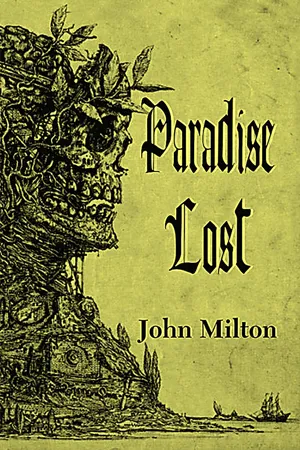
Paradise Lost Illustration(Source)
What I particularly love about this poem is its language. Milton uses elaborate metaphors, extraordinary imagery, powerful comparisons, and some absolutely magnificent epic similes. His descriptions are so vivid that you can almost visualise the enormous armies, the burning landscape of Hell, and the magnificent yet terrifying figure of Satan. Honestly, some of the dialogues are so powerful that you almost want to save them immediately. They are perfect examples of how classical literature can make even a fictional character's words sound incredibly philosophical and memorable.
Another interesting thing is that "Paradise Lost" is written in blank verse, which means unrhymed iambic pentameter. So, unlike many traditional poems, it does not depend on regular end rhymes. Instead, Milton creates musicality through rhythm, sound, alliteration, and the natural movement of his language. This is one of the reasons why the poem feels so grand and powerful even without a regular rhyme scheme.
I also find Milton's references to mythology, biblical stories, astronomy, and history particularly interesting. For example, there is a reference to Galileo, whom Milton calls the "Tuscan artist". It is fascinating to see a seventeenth-century poet bringing contemporary scientific discoveries into an epic poem about Heaven and Hell.
And if you enjoy collecting beautiful literary quotations for your notes, Instagram captions, or simply because a line sounds incredibly cool, this poem has plenty of them. Lines such as "Better to reign in Hell, than serve in Heaven" and "The mind is its own place" are some of the most memorable examples.
For me, "Paradise Lost" is not simply a religious poem about angels, demons, Heaven, and Hell. It is also a fascinating exploration of pride, ambition, freedom, power, leadership, and the consequences of rebellion. Let's explore some of the most interesting passages from Book I and understand why Milton's poetry continues to be so remarkable.
Read the complete poem: Paradise Lost by John Milton – Project Gutenberg
About the Poet
John Milton was an English poet, intellectual, and political thinker born on 9th December 1608. He is regarded as one of the greatest writers in English literature. His works are particularly known for their elevated language, classical references, religious themes, philosophical ideas, and extraordinary command of poetic expression.
"Paradise Lost" is his most celebrated work. It was first published in 1667 in ten books and later reorganised into twelve books in the 1674 edition. The epic is based on the biblical account of Satan's rebellion against God and the fall of Adam and Eve from Paradise. Milton explores the relationship between good and evil, free will, divine justice, temptation, and human disobedience.
Milton was also deeply interested in classical literature, history, philosophy, science, and theology. His knowledge of Greek and Roman mythology is visible throughout "Paradise Lost". He also makes references to contemporary scientific developments, including the astronomical observations of Galileo.
Interestingly, Milton became completely blind in the later part of his life, yet he continued his literary work with the help of others who assisted him in writing and recording his compositions. He died on 8th November 1674, leaving behind some of the most influential works in English literature.
The Opening Invocation and the Fall of Man
Of Man's first disobedience, and the fruit
Of that forbidden tree, whose mortal taste
Brought death into the World, and all our woe,
With loss of Eden, till one greater Man
Restore us, and regain the blissful Seat,
Milton begins "Paradise Lost" by introducing one of the most important events in Christian theology: the disobedience of Adam and Eve. The forbidden fruit becomes the starting point of humanity's suffering. By eating from the forbidden tree, Adam and Eve lose their innocence and bring sin, death, and suffering into the human world.
What I find particularly interesting is that Milton does not simply want to narrate a biblical story. He wants to explore the larger philosophical question of why humanity falls into sin and how divine justice operates. He also introduces the idea that humanity will eventually be restored through a greater figure, referring to Christ and the possibility of redemption.
The opening is important because it establishes the central subject of the entire epic. Although Book I focuses mainly on Satan and his rebellion, the larger story eventually leads towards Adam and Eve and the loss of Paradise.
Some words:
Disobedience: The refusal to follow an instruction or command. Here, it refers to Adam and Eve eating the forbidden fruit despite God's command.
Mortal taste: The act of tasting the forbidden fruit, which brings death and suffering into the human world.
Eden: The Garden of Paradise in which Adam and Eve originally lived before their fall.
Sometimes, a single act of disobedience can change the entire course of a story.
The Heavenly Muse and Milton's Purpose
Sing Heav'nly Muse, that on the secret top
Of Oreb, or of Sinai, didst inspire
That Shepherd, who first taught the chosen Seed
In the Beginning how the Heav'ns and Earth
Rose out of Chaos:
One of the most interesting aspects of Milton's opening is his invocation to the Heavenly Muse. In classical epic poetry, poets traditionally begin by asking a Muse for inspiration. Milton follows this tradition, but he gives it a distinctly Christian meaning.
Instead of simply calling upon a classical Greek goddess, Milton invokes a divine source of inspiration. He refers to the biblical tradition of Moses receiving inspiration from God and describing the creation of Heaven and Earth.
What I particularly like is how Milton combines the traditions of classical epic poetry with Christian theology. He is writing a religious epic, but he also wants his work to possess the grandeur and seriousness of the great classical epics.
His purpose becomes especially clear in one of the most important lines of the poem:
And justify the ways of God to men.
This line explains Milton's larger purpose. He wants to explore divine justice and explain why evil exists in a world created by an all-powerful God. It is one of the most important philosophical statements in the entire poem.
Some words:
Muse: A source of artistic or poetic inspiration. Milton invokes a divine Muse to guide his composition.
Oreb and Sinai: Mountains associated with the biblical experiences of Moses.
Chaos: The original state of disorder before the creation of the organised universe.
Great literature does not always begin with a story. Sometimes, it begins with a question that challenges the way we understand the world.
The Fall of Satan and the Fallen Angels
Him the Almighty Power
Hurled headlong flaming from th' Ethereal Sky,
With hideous ruin and combustion down
To bottomless perdition, there to dwell
In Adamantine Chains and penal Fire,
This passage describes Satan's defeat and his fall from Heaven. Satan was once a powerful angel, but his pride and rebellion against God resulted in his punishment. He is thrown out of Heaven along with the angels who supported him.
What makes this description particularly fascinating is the contrast between Satan's former glory and his present condition. He was once associated with heavenly light and beauty, but now he finds himself surrounded by darkness, fire, and suffering.
Milton makes Satan's fall feel enormous in both physical and psychological terms. The words "hurled headlong" create a sense of violent movement, while "hideous ruin and combustion" make the entire scene feel destructive and terrifying.
I also find the idea of fallen angels particularly interesting. They were once heavenly beings, but their rebellion has completely changed their position. They now have to live with the consequences of their decision.
Some words:
Ethereal: Extremely light, heavenly, or belonging to the upper spiritual world. Here, it refers to Heaven.
Perdition: A state of complete destruction or eternal punishment.
Adamantine: Extremely hard or unbreakable. Here, it describes the chains binding the fallen angels.
The most dramatic falls are sometimes those of characters who once stood at the very top.
The Terrifying Description of Hell
A Dungeon horrible, on all sides round
As one great Furnace flam'd, yet from those flames
No light, but rather darkness visible
Serv'd only to discover sights of woe,
Milton's description of Hell is absolutely extraordinary. He presents it as a terrifying place filled with fire, darkness, destruction, and suffering. It is almost like an enormous prison where the fallen angels are forced to experience the consequences of their rebellion.
One of the most interesting expressions here is "darkness visible". Honestly, I think this is one of the most beautiful and unusual descriptions in Book I. Normally, fire is associated with light, but Milton describes a place where the flames somehow produce darkness rather than illumination.
This is a paradox because darkness and visibility appear to contradict one another. However, the expression creates a disturbing atmosphere. The flames reveal the terrible surroundings without providing the comfort or hope normally associated with light.
I particularly love how Milton uses imagery to make the reader experience the environment rather than simply telling us that Hell is terrible. We can almost imagine the burning atmosphere, the endless suffering, and the complete absence of peace.
Some words:
Dungeon: A dark and miserable prison, often underground.
Furnace: An enclosed structure used for producing intense heat.
Darkness visible: A paradoxical expression suggesting a darkness that can somehow be perceived because of the surrounding flames.
Woe: Deep sorrow, misery, or suffering.
Sometimes, the most terrifying darkness is not the absence of light, but the presence of suffering without hope.
Satan Compared to a Great Sea Monster: Leviathan
That Sea-beast
Leviathan, which God of all his works
Created hugest that swim th' Ocean stream:
One of the most interesting epic similes in Book I is Milton's comparison of Satan to Leviathan, the enormous sea monster described in biblical tradition.
Milton describes Satan's gigantic body in such a way that a sailor might mistake him for an enormous island floating in the ocean. The comparison makes Satan appear almost unimaginably large.
What I find particularly impressive is how Milton uses a familiar natural image to communicate something supernatural. Instead of simply saying that Satan is enormous, he compares him to one of the largest creatures imaginable.
The comparison also has a deeper effect. Satan's physical size makes him appear powerful and intimidating, almost like a mythological monster. It contributes to the grand, larger-than-life atmosphere of the epic.
Some words:
Leviathan: A gigantic sea creature mentioned in biblical tradition.
Epic simile: An extended comparison used in epic poetry to develop a vivid and elaborate image.
Milton does not merely describe the size of his characters; he makes us imagine a scale beyond ordinary human experience.
Satan's Unconquerable Will and Determination
What though the field be lost?
All is not lost; the unconquerable Will,
And study of revenge, immortal hate,
And courage never to submit or yield:
Now this is one of my favourite moments in Book I! Despite losing the war against God, Satan refuses to consider himself completely defeated.
He believes that although he has lost Heaven, he still possesses his willpower, determination, hatred, and desire for revenge. He tries to convince himself and the other fallen angels that their defeat has not destroyed their ability to continue resisting.
What makes this speech so interesting is Satan's psychological strength. He understands that he has lost his position, his freedom, and his former glory, but he refuses to surrender mentally.
There is something almost theatrical about his confidence. He speaks as though defeat is merely another opportunity to prove his strength. However, Milton also makes us question whether this determination is actually courage or simply an expression of destructive pride.
The phrase "unconquerable Will" is particularly powerful. It suggests that although Satan's physical circumstances have changed, he believes his inner determination remains untouched.
Some words:
Unconquerable: Something that cannot be defeated or overcome.
Yield: To surrender or give up resistance.
Immortal hate: Hatred that Satan imagines will continue without end.
Sometimes, the mind refuses to accept a defeat that reality has already established.
Satan's Most Iconic Dialogue: Better to Reign in Hell
Better to reign in Hell, than serve in Heaven.
Honestly, this is probably one of the coolest and most memorable lines in the entire poem. It is one of those quotations that immediately catches your attention because of its confidence, simplicity, and powerful meaning.
Satan declares that he would rather rule in Hell than remain a servant in Heaven. This single statement tells us almost everything about his personality. He values power and independence above obedience. Even though Heaven represents perfection and Hell represents suffering, Satan would rather remain a ruler in a miserable kingdom than submit to someone else's authority.
What makes this dialogue particularly interesting is the way Satan presents his rebellion as a matter of personal freedom. He would rather have authority over himself and others than accept a position under God.
However, there is also an important irony here. Satan considers himself independent, but his actions are controlled by pride, hatred, and revenge. His idea of freedom is therefore quite different from genuine freedom.
I think this is one of the reasons why Satan is such an interesting literary character. His speeches sound powerful and sometimes even inspiring, but when we examine his motivations, we realise how deeply destructive his pride has become.
The desire to rule can sometimes become stronger than the desire to live in peace.
The Mind Is Its Own Place: Satan's Psychological Philosophy
The mind is its own place, and in itself
Can make a Heaven of Hell, a Hell of Heaven.
Another absolutely brilliant quotation! Satan suggests that the mind has the ability to transform how reality is experienced. Even if someone is physically present in Hell, the mind can create a sense of Heaven. Similarly, a person can experience Hell even in a place that should represent happiness.
I particularly like the psychological depth of this statement. It explores the relationship between external circumstances and internal perception. Our surroundings may influence us, but our thoughts and attitudes also shape our experience of the world.
This is also a beautiful example of paradox because Milton places Heaven and Hell in opposition while suggesting that the mind can reverse their meanings. The quotation sounds philosophical and almost motivational when read separately. However, in the context of Satan's character, it also reveals his attempt to convince himself that Hell cannot truly defeat him.
What makes the line even more interesting is its irony. Satan claims that his mind can overcome Hell, but his thoughts are still dominated by hatred, pride, and revenge. His mental world remains imprisoned by his own destructive emotions.
Sometimes, our greatest prison is not the world around us, but the thoughts we refuse to let go of.
Satan's Leadership and the Awakening of Fallen Angels
Awake, arise, or be for ever fall'n!
This is another powerful dialogue that reveals Satan's ability to influence others. After finding himself in Hell, Satan encourages the fallen angels to rise from their defeated condition. He does not want his followers to remain helpless. Instead, he motivates them to recover their strength and continue resisting God.
What I find interesting is that Satan behaves almost like a military commander here. He understands that his army needs confidence, unity, and a sense of purpose. His words are dramatic and commanding, almost like a motivational speech delivered before another battle.
The expression is particularly effective because it presents the fallen angels with a choice: rise and continue fighting, or remain defeated forever. Satan uses urgency and emotional pressure to bring his followers together.
However, his leadership is directed towards rebellion and revenge rather than anything morally good. This makes the passage particularly interesting from the perspective of characterisation.
Some words:
Arise: To rise from a lying or defeated position.
Fall'n: An older poetic form of fallen. Here, it refers to the fallen condition of Satan's followers.
A powerful leader can inspire an entire crowd, but the purpose behind that inspiration matters just as much.
The Fallen Angels Compared to Autumn Leaves
Thick as Autumnal Leaves that strow the Brooks
In Vallombrosa, where th' Etrurian shades
High over-arch'd embow'r;
One of the most beautiful epic similes in Book I is Milton's comparison of the fallen angels to autumn leaves scattered throughout the valleys and streams of Vallombrosa in Italy.
Milton uses this natural image to communicate the extraordinary number of angels lying across the surface of Hell. Instead of simply telling us that thousands of angels have fallen, he gives us a visual comparison that makes their number easier to imagine.
I particularly love this comparison because it combines natural beauty with a scene of destruction. Autumn leaves scattered across a landscape can create a beautiful picture, but here the same image represents a defeated army of fallen angels.
It is a wonderful example of how epic similes work. Milton takes something familiar from the natural world and uses it to describe something enormous and supernatural.
Some words:
Strow: An older poetic form of strew, meaning to scatter.
Vallombrosa: A beautiful wooded region in Italy, used by Milton as a reference in his comparison.
Etrurian: Relating to Etruria, an ancient region of Italy.
Sometimes, the most beautiful natural images can be used to describe the most terrible events.
Satan's Enormous Spear and the Heroic Imagery
His spear, to equal which the tallest Pine
Hewn on Norwegian hills, to be the Mast
Of some great Ammiral, were but a wand,
Milton describes Satan carrying an enormous spear that is compared to a tall pine tree from the Norwegian hills, which could be used as the mast of a great ship. Even that enormous tree would appear like a small stick beside Satan's weapon.
What I find interesting is the way Milton uses such an elaborate comparison to describe Satan's physical proportions. He does not simply tell us that the spear is large. He compares it with something that is already enormous and then makes that object seem insignificant.
The image also contributes to Satan's heroic appearance. Even though he is a fallen angel, Milton continues to describe him using the grand language traditionally associated with epic heroes.
This is one reason why Satan is such a fascinating literary character. He is presented with the physical grandeur of a heroic figure, even though his actions and motivations are morally questionable.
Some words:
Hewn: Cut or shaped using a tool.
Mast: A tall vertical structure on a ship that supports its sails.
Wand: A thin stick or rod. Here, it emphasises how enormous Satan's spear is.
Milton gives even his fallen characters the grandeur and scale of legendary heroes.
Satan's Shield and the Reference to Galileo
The broad circumference
Hung on his shoulders like the Moon, whose Orb
Through Optic Glass the Tuscan Artist views
This is one of my favourite literary references in Book I because it brings together poetry, science, and astronomy.
Milton compares Satan's enormous shield to the moon as seen through a telescope. The comparison helps readers understand just how gigantic the shield is. It is so large that it appears almost like a celestial body.
The particularly interesting part is the reference to the "Tuscan Artist". Milton is referring to Galileo Galilei, the Italian astronomer and scientist who made important astronomical observations using a telescope.
I find this reference fascinating because Milton brings contemporary scientific knowledge into a religious epic. He does not limit himself to biblical stories and classical mythology. He also draws upon the intellectual developments of his own time.
The phrase "Optic Glass" refers to the telescope, while the "Tuscan Artist" identifies Galileo through his Italian origin.
Some words:
Orb: A spherical or circular object. Here, it refers to the moon.
Optic Glass: An optical instrument, referring to Galileo's telescope.
Tuscan Artist: Galileo Galilei, who came from Tuscany in Italy.
One of the beautiful things about classical poetry is how it connects literature with the scientific and intellectual world of its time.
The Creation of Pandemonium: The Capital of Hell
A solemn Council forthwith to be held
At Pandemonium, the high Capital
Of Satan and his Peers,
Towards the end of Book I, Satan and his followers decide to establish a magnificent palace in Hell called Pandemonium. It becomes the meeting place and capital of the fallen angels.
What I find particularly interesting is the contrast between the terrible environment of Hell and the magnificent structure created by its inhabitants. The fallen angels construct a grand palace that becomes a symbol of their authority, organisation, and ambition.
The name Pandemonium is particularly interesting. It is formed from the Greek elements "pan", meaning all, and "daimon", meaning spirit or demon. Milton uses it to name the grand assembly place of the demons.
The construction of Pandemonium is described with extraordinary detail. The building almost resembles a magnificent royal palace, and the fallen angels gather there to discuss their future plans.
I also find it interesting that the end of Book I shows Satan's rebellion becoming an organised political and military system. The fallen angels are no longer simply a defeated army lying in Hell. They now have a kingdom, a meeting place, and a leader.
Some words:
Pandemonium: The capital or meeting place of Satan and the fallen angels.
Peers: People of equal rank or status. Here, it refers to Satan's fellow fallen angels.
Solemn Council: A formal and serious assembly held to discuss important matters.
Even in defeat, ambition finds a way to build its own kingdom.
Some More Interesting Aspects of Paradise Lost
Apart from the major passages, there are several other things that make Book I particularly interesting. Milton's language is full of philosophical ideas, biblical references, and unusual descriptions.
One of the most interesting aspects is the way Satan is presented. He has traditionally heroic qualities such as courage, ambition, leadership, and determination. However, these qualities are driven by pride and revenge.
Another important aspect is Milton's use of blank verse. Unlike traditional rhyming poetry, blank verse does not depend on a fixed rhyme scheme. Milton uses unrhymed iambic pentameter, allowing him to create long, flowing sentences and a grand poetic rhythm.
The poem also contains numerous classical and biblical references. These references make the work intellectually rich and show Milton's extraordinary knowledge of literature, mythology, history, religion, and science.
Some important literary devices:
Epic Simile: An elaborate comparison used to describe something on a grand scale. Satan's comparison to Leviathan and the fallen angels' comparison to autumn leaves are excellent examples.
Metaphor: A comparison in which one thing is described through another. "The mind is its own place" is a particularly interesting example.
Paradox: A statement that appears contradictory but expresses a deeper meaning. "Darkness visible" is one of the most famous examples.
Allusion: A reference to another literary, historical, religious, or cultural work or figure. Milton's references to Leviathan, biblical figures, and Galileo are examples.
Imagery: Descriptive language that appeals to the senses. Milton's descriptions of Hell, fire, darkness, and Satan's enormous physical appearance create powerful visual imagery.
Symbolism: The use of objects or images to represent larger ideas. Heaven, Hell, fire, darkness, and the fall all carry symbolic meanings.
Blank Verse: Unrhymed poetry written in iambic pentameter. Milton uses this form throughout the epic.
The beauty of Milton's poetry lies not only in what he tells us, but also in the extraordinary way he chooses to express it.
My Favourite Quotations and Their Meanings
If there is one thing I would recommend doing while reading "Paradise Lost", it is saving some of its most memorable quotations. Milton's language is so powerful that many of his lines can stand independently as philosophical statements.
Better to reign in Hell, than serve in Heaven.
This is Satan's famous declaration of pride and ambition. He would rather rule in Hell than submit to God's authority in Heaven.
The mind is its own place, and in itself
Can make a Heaven of Hell, a Hell of Heaven.
This quotation explores the relationship between the mind and external circumstances. It suggests that our perception can influence how we experience the world.
All is not lost; the unconquerable Will.
Satan refuses to accept defeat and believes that his determination remains even after losing Heaven.
Awake, arise, or be for ever fall'n!
Satan uses this dramatic statement to encourage the fallen angels to rise and continue their resistance.
No light, but rather darkness visible.
This extraordinary paradox describes the disturbing atmosphere of Hell, where the flames reveal suffering rather than providing illumination.
Another important quotation appears later in Book III:
Freely they stood who stood, and fell who fell.
This statement explains the importance of free will. The angels who remained loyal to God did so through their own choice, while those who rebelled were responsible for their fall.
I particularly like how these quotations cover such different aspects of human and spiritual experience: ambition, freedom, pride, determination, perception, and responsibility.
Some literary quotations stay with us because they express an entire philosophy in just a few lines.
In my view, "Paradise Lost" is one of those literary works that deserves to be appreciated not only for its religious significance but also for its extraordinary language, characterisation, and philosophical depth. What I particularly love about Book I is the way Milton presents Satan. His speeches are incredibly powerful, his personality is complex, and his determination makes him such a memorable literary character.
Lines like "Better to reign in Hell, than serve in Heaven" and "The mind is its own place" are so beautifully constructed that they continue to be quoted even centuries after the poem was written. They are the kind of lines that make you pause and think about ambition, freedom, power, and the way people justify their own decisions.
I also love Milton's use of epic similes. The comparisons involving Leviathan, autumn leaves, the moon, and Galileo's telescope show just how imaginative and intellectually rich his poetry is. His descriptions are so elaborate that even the most extraordinary supernatural events become almost visual experiences.
Another thing worth appreciating is the contrast between Satan's grand language and his actual intentions. He speaks like a heroic leader, but underneath that impressive exterior lies pride, hatred, and an endless desire for revenge. I think this contrast is one of the most fascinating aspects of his character. He is presented with qualities that can appear admirable, but those qualities are ultimately directed towards destruction.
For me, that is what makes "Paradise Lost" particularly interesting. It is not simply a poem about Heaven, Hell, and the fall of angels. It is also about ambition, power, ego, freedom, leadership, and the dangerous consequences of pride. Milton creates a world in which even the most powerful speeches can make us question the difference between genuine courage and destructive arrogance.
And honestly, if you enjoy classical literature, philosophical dialogues, beautiful metaphors, dramatic characters, and quotations that make you stop and think, John Milton's "Paradise Lost" is absolutely worth reading. It is one of those works where the language itself is an experience!
I hope you enjoyed reading my perspective on Book I of this magnificent epic. I would love to hear your thoughts, especially about Satan's character. Do you find him fascinating despite his morally destructive actions? Or do you think his pride completely overshadows his impressive qualities?
If you are studying "Paradise Lost" or simply want to explore it in greater detail, I have also collected additional notes, important passages, quotations, and explanations that you may find useful.
Explore more: Paradise Lost: MA English Notes on GitHub.
I absolutely love classical poetry, especially works rich in metaphors, philosophical dialogues, supernatural imagery, psychological depth, and elaborate language. I am always happy to discover something new, so feel free to reach out to me with your favourite literary works or recommendations!
Leave a comment 💬
Choose a message to share your thoughts about this article.
Your email app will open with your comment ready to send.